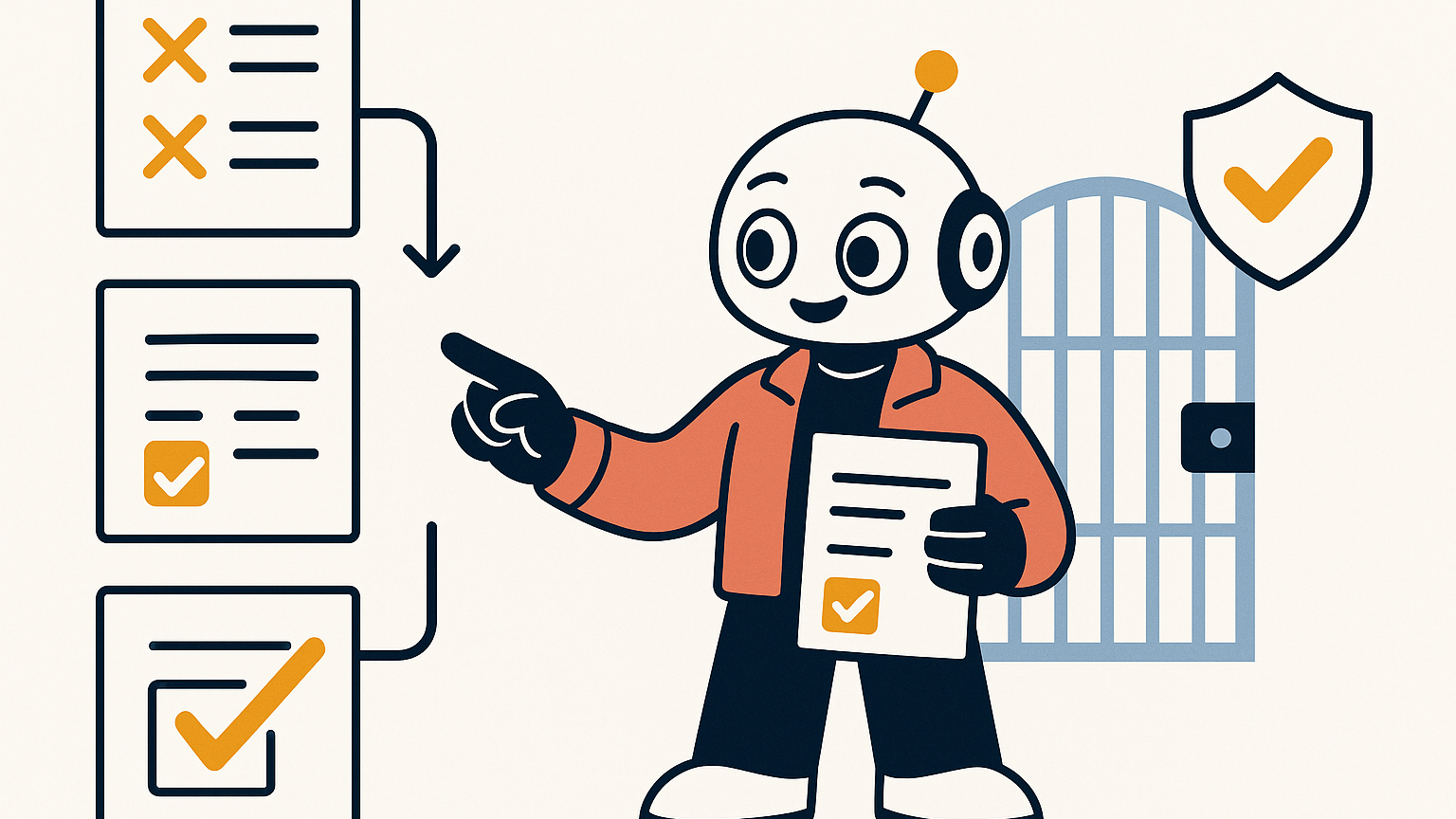
Set up the pilot with targeted, mandatory human review points within the AI workflow, rather than continuing to perform the full manual analysis in parallel. Decide in advance how many outputs you will review, explicitly assign production and independent review, make supporting evidence immediately available, and keep a traceable record of every decision, correction, and escalation.
In brief: review gates in an AI market-analysis pilot
This lets you retain substantive quality control over AI-generated market insights without unnecessarily undermining the pilot’s scalability and turnaround time.
- Replace duplicated manual work with defined reviews at the points where analyst judgement is needed to accept a market conclusion.
- Align the review burden with the risk: additional handoffs and waiting time are useful only when they add an independent substantive assessment.
- Choose in advance between maximum inspection coverage and a scalable review approach that accepts an explicit residual risk.
- Separate the preparation of AI output from its assessment, and record handoffs and follow-up actions as fixed workflow steps.
- Ensure reviewers can assess evidence directly alongside the conclusion and that the complete decision context remains reconstructable later.
Prevent the AI pilot from running two complete workflows in parallel
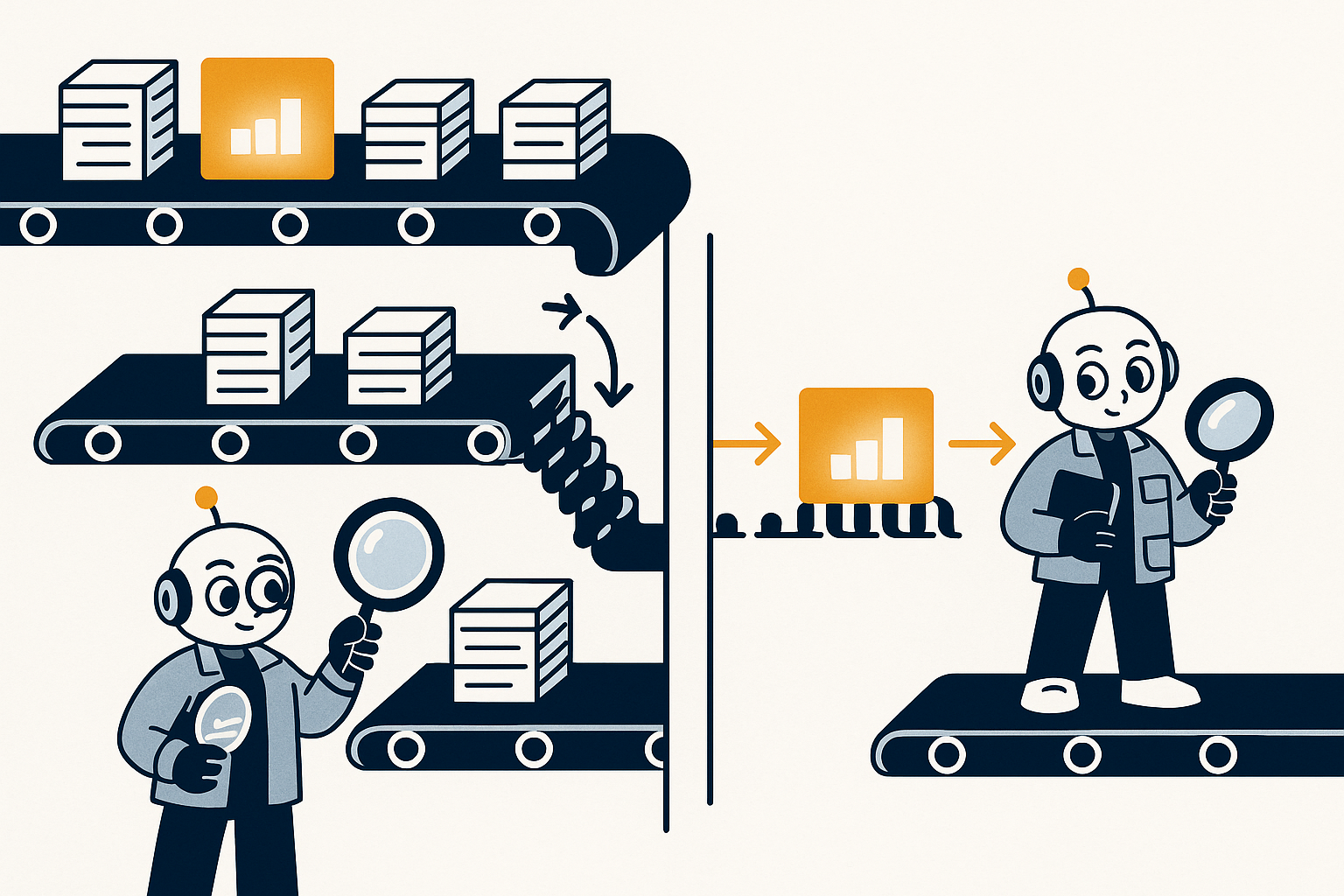
An AI market-analysis pilot does not retain quality control by fully reproducing every AI output through the existing manual route. That distinction determines whether the pilot is genuinely testing a new way of working or merely adding another layer to the existing process. When analysts, out of distrust, continue to perform all steps of traditional market analysis manually alongside the AI method, what is known as Parallel Run Purgatory emerges: two complete routes effectively produce the same work.
At first glance, this situation appears cautious. After all, the organisation retains its familiar manual control. In practice, however, the pilot shifts from testing the quality of AI-generated market insights to a permanent comparison between two complete production chains. The AI output can proceed only once the manual route has already produced a complete result of its own. As a result, it is not clear which components can move faster, which reviews genuinely make a difference, and which handoffs in an adapted workflow provide sufficient assurance.
The direct consequence is that productivity gains fail to materialise. Not because AI output cannot, by definition, make a useful contribution, but because the workflow leaves no room to assess that contribution independently within defined controls. Scalability also remains unproven: a process that retains the entire old workflow as a parallel requirement for every new market conclusion requires the same manual effort as volume grows.
The boundary for the pilot therefore lies not between having or not having human control, but between targeted control and full duplication. Targeted control keeps analysts involved at the points where their assessment matters for accepting an outcome. Full duplication, by contrast, treats the AI route as though it may never independently form a controlled part of the process. A pilot becomes informative only when it shows which manual activities are replaced by reviewing AI output without eliminating substantive quality control. If the traditional route continues in full, the pilot primarily measures its own distrust rather than the usefulness or scalability of the new workflow.
Sources for this section: mit.edu
The practical boundary lies between fast throughput and sufficient review depth
Review gates are proportionate control points in the flow of AI-generated market insights. They determine not only whether a conclusion is assessed, but also how much review work the pilot attaches to each pass. This makes a tension visible that cannot be designed away: speed and review depth do not naturally move in the same direction.
A large number of mandatory review gates can extend turnaround time to such an extent that AI’s productivity advantage evaporates. This does not happen only when an individual assessment takes a long time. Every mandatory handoff, waiting period, and feedback loop also lengthens the route before a market conclusion becomes available for further strategic assessment. If the pilot requires new approvals for every outcome, the constraint shifts from analysis production to review capacity. AI may then provide material more quickly, but the organisation does not experience that benefit in actual throughput.
The opposite mistake is overly light control. When gates are absent or so limited that incorrect conclusions can pass through unnoticed, the risk of strategic miscalculations increases. Market insights often support subsequent decisions. An error that goes unrecognised at that stage can therefore have effects beyond the original analysis. Reputational damage is a second possible consequence when insufficiently reviewed conclusions are treated as reliable.
The useful boundary is therefore not an aim for as much or as little control as possible. The pilot requires an explicit trade-off between the turnaround time caused by mandatory gates and the review depth needed to handle market conclusions responsibly. A gate serves a purpose when it enforces an assessment that would otherwise be absent; it loses that purpose when it merely adds another queue without an independent substantive review. Based on that distinction, a team can determine whether the review burden still supports the pilot’s purpose: fast throughput of AI-supported analysis, with sufficient protection against strategic errors and reputational damage.
Choose in advance between full review and sampling with residual risk
The review method should be established before assessment begins. Full review and sample-based review are both defensible forms of review, but they make different choices about risk management, capacity, and scalability. If that choice changes during the review of individual outputs, the result is not consistent review depth but an implicit assessment that may vary from moment to moment.
| Aspect | Full review | Sample-based review |
|---|---|---|
| Review coverage | All AI market claims are inspected. | Part of the AI market claims is reviewed. |
| Risk management | Maximises risk management because every claim is inspected. | Accepts a calculated residual risk of anomalies outside the reviewed selection. |
| Required review capacity | Requires assessment of all outcomes and therefore places greater demands on review capacity. | Limits the required assessment to the selected outcomes. |
| Scalability | Is constrained because the review volume grows with every AI market claim. | Is supported because not every claim needs to be inspected in full. |
| Explicit choice in the pilot | The pilot chooses maximum coverage as its starting point and accepts the limitation on scalability. | The pilot chooses scalability as its starting point and makes the residual risk of anomalies explicit. |
The table makes clear that sampling does not mean the absence of quality control. The review still takes place, but it is based on accepting that anomalies outside the selection cannot be entirely ruled out. Full review follows the opposite pattern: coverage is maximal, while the ability to apply the workflow at greater scale is constrained. Neither option is a neutral standard.
For the pilot, this means that the chosen method specifies in advance which risk the organisation wants to manage and what review burden it accepts. The choice then becomes a fixed part of the workflow instead of a changing response to confidence in an individual output. It also makes clearer afterwards what the pilot tested: maximum inspection of all AI market claims, or scalable review with an explicit residual risk.
For each review gate, define who produces, who independently reviews, and where the handoff occurs
Role separation makes a review gate executable as part of the workflow, rather than a general expectation that someone will look at the output later. The following definition uses the four-eyes principle as its starting point: the AI prompter produces or prepares the AI output, while an independent reviewer performs the assessment. This separation supports objectivity, but also requires additional staffing and operational coordination compared with self-validation.
- Define the producer, reviewer, and handoff for each gate. Explicitly state whether the AI prompter and the independent reviewer perform different roles. Then define where the output leaves the producer and reaches the reviewer, so the handoff does not depend on an informal arrangement. Also record the point at which the assessment is marked and how the outcome returns to the producer when follow-up action is needed. The four-eyes principle supports objectivity because the assessment does not rest solely with the person who prepared the AI output. That objectivity is not without cost, however: strict role separation increases the required staffing and creates additional coordination among those involved. The pilot makes this burden visible by treating not only the separate roles but also the activities around the handoff as part of every gate. Self-validation involves less of this additional coordination, but does not provide the same independent review. The choice is therefore not about an abstract preference for more control, but about the operational capacity required to ensure independent assessment takes place consistently.
Sources for this section: stanford.edu
Without direct source links, review becomes reconstruction work
A reviewer can assess a market conclusion substantively only when its supporting evidence is directly available. Without that connection, the assessment begins not with the conclusion itself, but with determining how that conclusion was reached. The review then becomes reconstruction work: first finding relevant evidence, then establishing which data point or parameter was used, and only then conducting the substantive assessment.
- Link every generated market conclusion directly to its supporting evidence. Zero-click source traceability means that every conclusion links directly to specific source documents, data points, or dataset parameters. The reviewer therefore does not need to rebuild the supporting evidence before the substantive review can begin. This direct availability shifts attention to the relationship between the market conclusion and the evidence on which it rests. A source document can be viewed alongside the conclusion to which it is linked; the same applies to a data point or dataset parameter that was used. This makes source traceability part of the review moment itself, rather than a separate search task before or after assessment. The review does not become lighter: it becomes more specific, because the reviewer can directly assess what supports the conclusion. Without this connection, capacity is lost to reconstructing the evidence chain, whereas substantive assessment is precisely the function of the gate.
How do the NIST AI RMF and Article 14 fit review gates in a pilot?
The NIST AI RMF and the requirements for human oversight under Article 14 of the European AI Act can serve as reference points for a pilot in which AI supports market insights. They do not replace the review workflow and do not constitute an independent legal assessment in this context. Their value lies in structuring attention to AI risk management and demonstrable human control while existing analysis routines change.
- The NIST AI RMF provides alignment for AI risk management. A pilot can use this framework to place review gates within a broader approach to risk and quality assurance around AI. This means a gate is not viewed solely as an operational approval, but as a point at which the organisation controls the AI-supported analysis. This alignment helps connect the review workflow to risk management without suggesting that the framework itself determines how every market conclusion must be assessed.
- Article 14 focuses attention on human oversight. The requirements for human oversight under Article 14 of the European AI Act align with a pilot in which analysts are not merely present but remain visibly involved in assessing AI-generated outcomes. Review gates can give that involvement a fixed place in the workflow. This is not a statement that a specific pilot fully complies with legal obligations; it indicates that the design of human assessment aligns with the theme of oversight.
- Use both frameworks to support pilot control. Together, they provide language for two distinct questions: how is risk around AI managed, and how does human control remain recognisable in the process? For an AI market-analysis pilot, this combination supports documenting review gates as control points without separating the frameworks from the actual workflow. The pilot thus maintains a link between risk management, human oversight, and the assessment of market insights.
Sources for this section: nist.gov, sanctity.ai
A review gate becomes a workable pilot control only when decisions can be retrieved

A review gate is more than a moment when an analyst approves or intervenes. It becomes verifiable when it can later be determined what that decision was based on and what change was subsequently made. To achieve this, the pilot needs a transparent and immutable decision audit log that does not store a single element in isolation, but preserves the relationship between model versions, inputs, analyst decisions, manual corrections, and escalations.
That relationship determines the meaning of an intervention. A manual correction without a recorded input does not reveal whether the correction resulted from the material underlying the analysis. Likewise, an analyst decision without a model version does not show within which version of the AI used the decision was made. And an escalation without documented corrections leaves open what had already been adjusted before the escalation. Separate records may therefore be administratively present while the assessment as a whole can no longer be reconstructed.
An immutable log brings these components together around the same review action. This keeps interventions auditable: the pilot can see which input was available, which model version the output was associated with, which decision the analyst made, and whether correction or escalation followed. This does not replace substantive assessment, but records that this assessment genuinely had a traceable place in the workflow.
For operational design, this means that a gate closes only when the record is also complete. Otherwise, a costly investigation into the cause of a deviation may arise later, without sufficient information to assign responsibility. If the model version, input, analyst decision, manual correction, or escalation is missing, it cannot be established whether the deviation resulted from the model, the input, or the human decision.
This article does not provide legal advice. Applicable obligations depend on the system’s purpose, functionality, user context, and risk classification. Have the specific application legally assessed before production use.