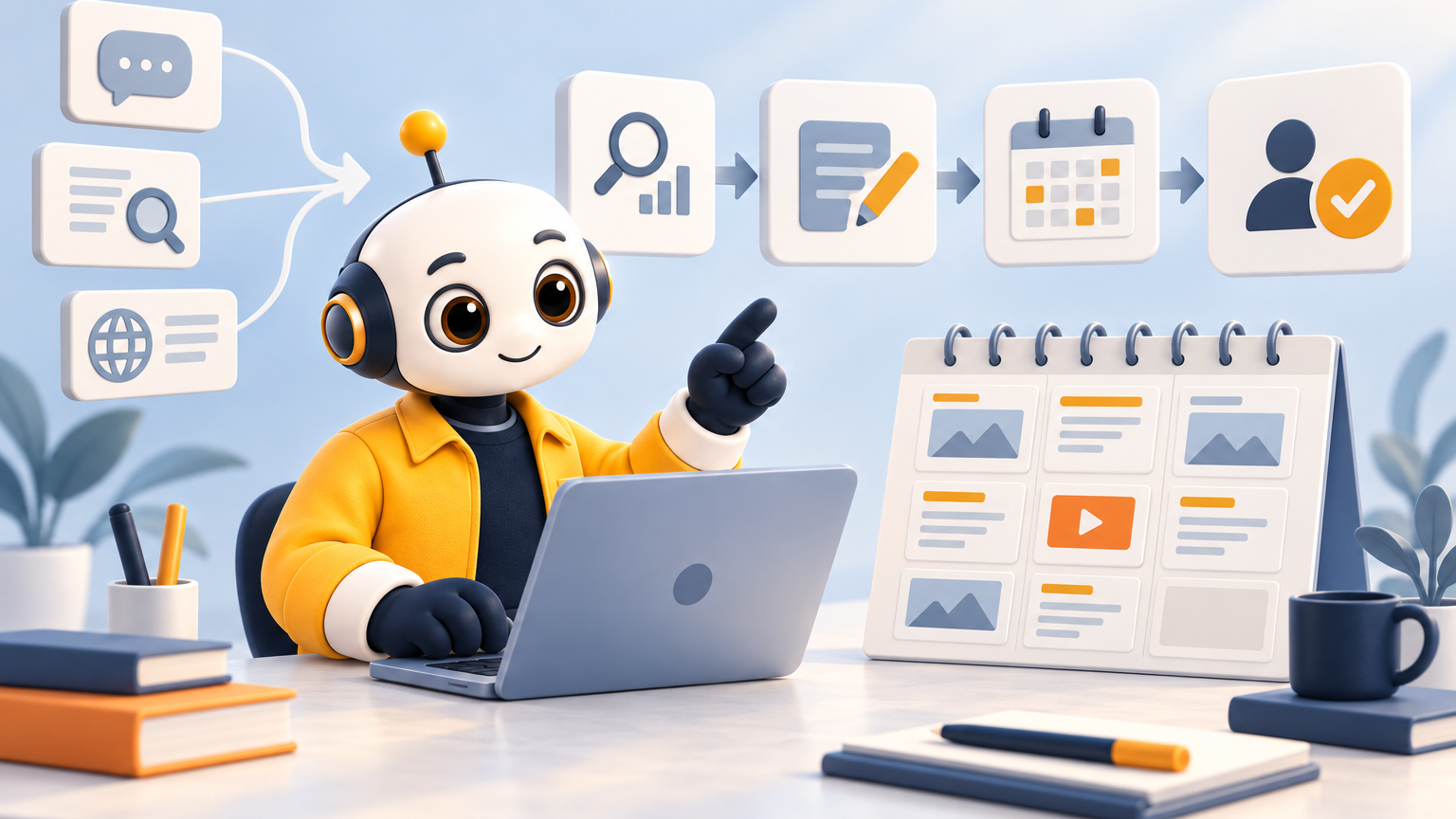
Integrate AI as a preparatory link in one continuous planning workflow: let AI conduct research, organise information and perform overlap checks based on documented business context, but let people assess brand fit, priority, factual substantiation and final calendar placement. Only move a topic into production when the required briefing information has been validated and an accountable person has approved it to proceed.
Key takeaways from this article
AI increases the efficiency of content planning when it reduces manual handovers and incomplete proposals, without handing over strategic decisions.
- Provide AI with up-to-date knowledge about audiences, value propositions, buying motivations and editorial principles, so proposals align with your own market rather than general web patterns.
- Assess new topics before adding them to the calendar for overlap with existing content, search intent, distinctiveness and business relevance.
- Make the transition from research to briefing and calendar conditional on complete, verified metadata, so writers start from a usable foundation.
- Align roles and checks with team size: keep the review compact where possible, but explicitly document ownership, handovers and approvals when multiple teams are involved.
How does AI fit into content planning without human control disappearing?
AI fits well into content planning when it prepares topic proposals within clear boundaries and an employee decides what goes into the calendar. Quality depends on the knowledge AI receives, the checks performed before approval and how responsibilities are divided.
Therefore, do not start with a standalone prompt to generate ideas. Use a central knowledge layer: a shared, maintained source, such as a repository, wiki or fixed planning document, where segmentation, product positioning and editorial style guides are documented. This context determines whether AI develops topics that align with your market and brand, or falls back on generic lists without a clear unique angle.[1]
AI can then compare new proposals semantically with existing publications and calendar items. This reveals where two topics are too similar and where keyword cannibalisation may arise. This comparison should take place before a calendar entry is created, not only once a writer is already working with a brief.[2][1]
The human role therefore lies primarily in assessment. In compliance-sensitive markets, a subject-matter expert can supplement the briefing review by assessing factual claims and potential compliance risks before a topic proceeds.[3]
The setup of this review also differs by team. A compact team can work with one strategic reviewer. In an enterprise environment, multiple roles require formal workflow statuses and explicit permissions to hand work over between stages.[2][3] This keeps it clear who enriches a proposal, who approves it and who schedules it. AI then accelerates the preparatory work, while priority and the final decision remain with the people who oversee the market, brand and planning.
Why standalone AI ideas often slow down content planning
The delay usually does not arise when ideas are generated, but when plausible-sounding proposals move on to briefing without assessment. Generic keywords without brand context or business priorities can produce a long list of themes that seem suitable at first glance. Only when a writer has to turn one into a usable angle does it become clear that the topic has no clear relationship with the chosen priority. Briefs then need to be rewritten, and the corrective work shifts to the editorial team and content calendar.
The shared knowledge layer gives that choice a fixed starting point. Without such documented context, AI primarily draws on public search volumes and general competitor patterns. As a result, the calendar may contain topics that offer little distinction or insufficient depth for decision-makers.
Under time pressure, the handover from research to briefing is sometimes made too quickly. Missing briefing fields and unresolved choices then remain in the proposal until an editor needs to work with it. The review ultimately takes more time because the assessment is no longer about a defined topic with complete input, but about fixing an incomplete starting point.
Automated quality control can check before human review whether a proposal aligns with the editorial style guide and whether mandatory briefing fields have been completed. This means the reviewer does not first have to reconstruct basic information and can focus on whether the topic truly fits the brand and priority.
From a full backlog to topics that can actually be planned

Three ways of working can quickly make an AI-supported content calendar more burdensome rather than faster to manage.
- Unfiltered backlog. When hundreds of AI proposals land directly on the calendar board, the overview needed to weigh topics against one another disappears. Items without a clear priority get pushed forward and still require sorting time later. An unfiltered approach may quickly fill a ninety-day calendar, but it also increases the likelihood that topics align with the mediocrity of existing competitor publications rather than offering a recognisable unique perspective.
- Superficial review. A check limited to grammar and spelling leaves other questions unanswered: does the topic fit the brand, has the substantiation been verified and does it add meaningful value? The review then appears complete, while it is still unclear whether a proposal is suitable for the content calendar. This causes extra assessment once the topic is already further along in the planning process.
- Disconnected AI chats. Separate chats and manually copied snippets into spreadsheets break the connection between intake, selection and calendar management. At handover, it is no longer clear which input and previous choices underpin a proposal. Employees have to gather that information again, bringing back manual steps and preventing planning from building on earlier decisions.
How to move AI output from intake to the content calendar
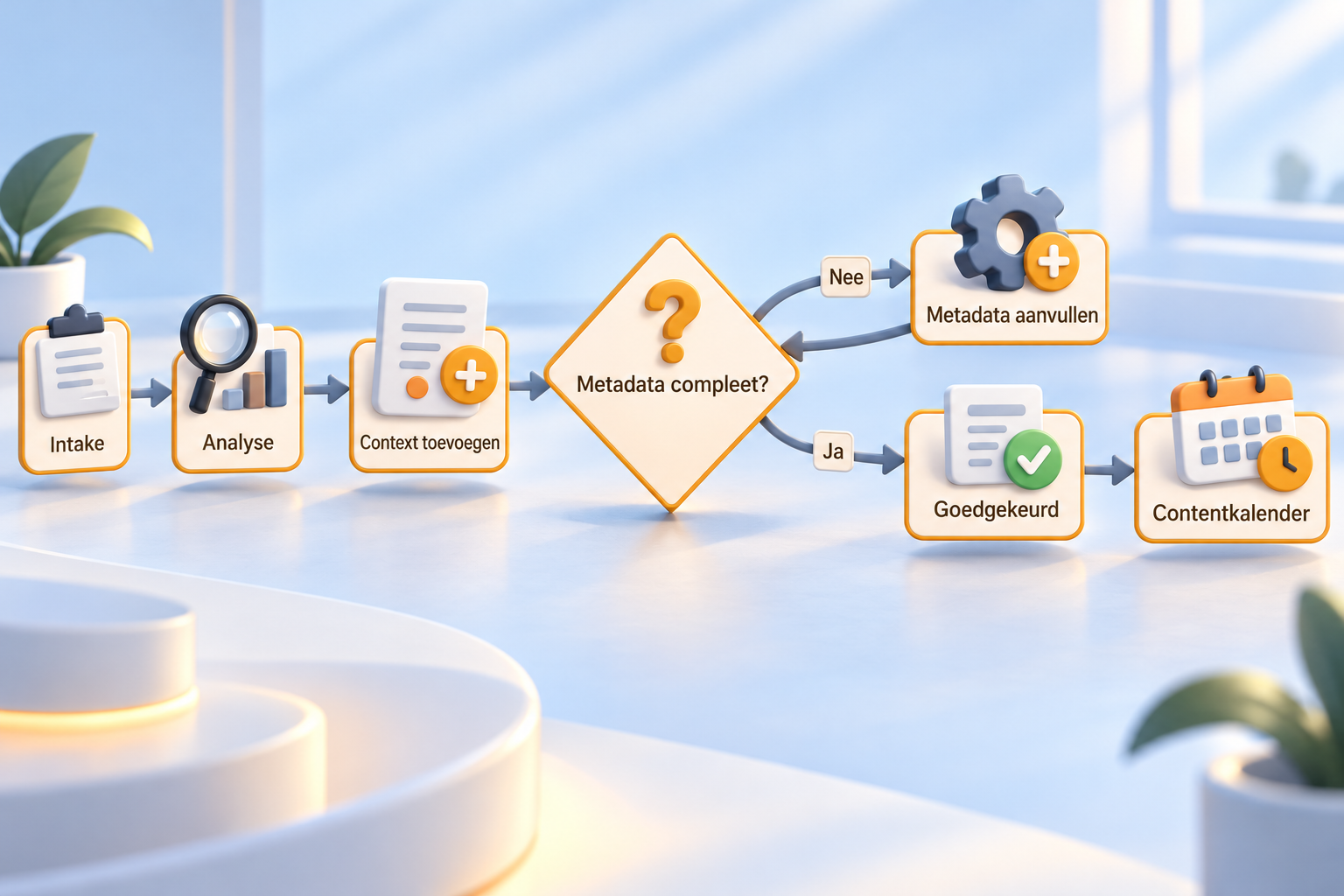
Make every calendar item the outcome of one continuous process. AI processes and organises information; people determine the context, approve the metadata and safeguard calendar capacity.
- Connect intake to analysis. Link trend detection, search intent analysis, semantic clustering and synthesis directly to the calendar entry. By connecting these steps, employees do not have to repeatedly transfer raw data between separate planning stages.[2]
- Give topics a fixed context. Use the previously described central knowledge layer as the source for personas, segmentation data and buying motivations. This enables AI to prepare specific opportunity blueprints rather than proposals based on a general view of the web.[1] At Content Studio, this process aligns with the sequence of market analysis, segmentation, Decision Intelligence, Opportunity Blueprints and planning.
- Make the calendar handoff conditional. Only allow a topic to receive the status ‘approved for production’ once fixed metadata have been validated. Consider the angle, target intent and the commercial pain point the topic addresses. As a result, the writer does not receive a standalone idea, but a verifiable starting point.[2][3]
- Keep review gates purposeful. A review gate can safeguard brand fit and prevent content waste. For example, let such a gate check whether the angle is distinctive, the target intent has been completed and substantiation is available. Too many gates, however, make the process slow and can cause review fatigue; therefore, limit checks to decisions about direction, evidence or progression.[2]
More efficient content planning requires a verifiable handover
AI-supported content planning only delivers lasting time savings when the content calendar remains explainable and verifiable. For each topic, it should be clear why it takes precedence based on search intent, market data and commercial buying motivations. A brief should also refer back to the research data on which factual claims and statistics are based, so the editorial team can verify them before production begins. This turns AI output into a substantiated starting point rather than extra material that first needs to be researched again.
This conclusion does not hold when responsibilities and handovers remain unclear. Writers may then primarily be proofreading AI texts, while content managers lose oversight because of constantly shifting deadlines. Separate specialist solutions for, for example, keywords and calendar management can also cause additional manual handovers and data loss. An integrated approach does not prevent this automatically, but it does make visible what information belongs to a topic, which check remains open and who makes the next decision. Without that overview, the time savings shift to review work and calendar management.