
Assess AI recommendations based on external impact, uncertainty, and reversibility, and keep them explainable through an unbroken, auditable provenance chain from market analysis to CMS publication. Mandatory human approval is needed before hard-to-reverse choices with major external consequences, such as market segmentation and quarterly priorities; reversible internal edits can be reviewed and corrected by teams without formal executive sign-off.
Quick overview: human approval of AI decisions
Effective AI governance directs human attention toward decisions that set direction, while recoverable work can continue within the team.
- Distinguish between an ordinary review and a formal stop/go point: without required sign-off, execution must not proceed.
- For every strategic recommendation, document the assumptions, uncertainties, assessment, and execution in context, so the published outcome can be traced back to the original analysis.
- Prevent central brand governance from unnecessarily slowing local decision-making by making bounded local exceptions identifiable and assigning clear accountability to them.
- Check whether technical permissions for generating, reviewing, and publishing are appropriately configured so AI output cannot be published externally on its own.
- Avoid both an overly open route without an accountability trail and overly broad manual control that causes waiting times and handoffs.
Which AI decisions require a mandatory approval gate?
Use a mandatory approval gate for AI recommendations that have external effects and are difficult to reverse later. Allow reversible internal edits to be visibly reviewed without making them a formal executive stop/go point every time.
| Type of recommendation | Characteristics | Appropriate human control | What must be demonstrable before execution |
|---|---|---|---|
| Decision with high external impact and low reversibility | The recommendation sets a direction that affects matters beyond the team. A decision may affect reputation, market approach, or the direction of the content strategy. Reversing it later requires more than a minor editorial correction. | Mandatory executive approval. The recommendation pauses before execution. An accountable leader approves, modifies, or rejects the proposed direction. | The selected direction, the assumptions underlying it, the uncertainties, and why this decision cannot be treated as an ordinary edit. |
| Reversible internal edit | The edit supports work within the content chain and can be adjusted without establishing an external strategic position. The outcome remains visible for review. | Reviewable assistance. A team can inspect and correct the outcome without needing to escalate every step through an executive route. | The edit, the input used, and the ability to assess or reverse the outcome before it has further effects. |
| Human review without a formal gate | A reviewer reads, compares, or corrects a proposal. This action is valuable, but becomes an approval gate only when execution cannot continue without that sign-off. | Operational review. The reviewer safeguards the quality of the work but does not necessarily make a formal decision on behalf of the organization. | Who reviewed it, what was changed, and whether that review was merely commentary or required approval for the next step. |
The distinction is therefore not whether AI is involved in a step, but the consequences of the recommendation and the room to correct an error. Strategic reversibility and risk of harm determine the appropriate governance regime: decisions with high external impact and low reversibility require mandatory executive approval gates, while reversible internal edits can fall under reviewable assistance.[1][2]
This classification prevents two extremes. Without a mandatory gate, AI advice can quietly turn into a de facto directional decision. With a formal gate on every edit, however, a chain of waiting times arises in which leaders must also handle small, recoverable actions. Therefore, assess each recommendation based on what it establishes, who bears the consequences, and how much room remains to reverse course after execution.
When should an AI recommendation reach executives?
An AI suggestion can be part of the regular work discussion; a recommendation about market segmentation or quarterly priorities, by contrast, establishes a direction that affects matters beyond the content team. The difference is not whether AI produced the recommendation, but what the chosen direction establishes for the integrated content chain. Market segmentation determines which audiences are central to content research. Quarterly priorities influence which topics and opportunities subsequently receive attention. Both decisions can have structural external consequences.
Do not assess such recommendations using only the label “strategic.” Consider them through three questions: how great is the impact, how much uncertainty remains, and how readily can the choice still be reversed? That combination prevents two misconceptions. A proposal with broad consequences does not automatically deserve executive attention if it can be revised without major consequences. Conversely, an apparently limited choice may require more stringent assessment when uncertainty is high and later correction affects the entire prioritization.
For market segmentation and quarterly priorities, this assessment leads to a mandatory approval gate before execution. The recommendation does not automatically flow into planning or further processing. First, executive sign-off is required for the direction being set; only then can that direction affect content research and prioritization. This links human accountability to the point at which a proposal moves from analysis to a direction-setting choice.
Executives therefore do not need to assess every content edit, text, or intermediate step. Their role begins with the limited category of recommendations where impact, uncertainty, and limited reversibility converge. Teams can handle the remaining work within their own rhythm. When evaluating an AI-driven content strategy platform, it should therefore be clear whether such targeted pause points can be configured before execution, rather than spreading human review across every workflow step.
When does central control slow local content decisions?

The same proportionality applies to local exceptions: not every deviation from a central guideline needs to follow the same escalation route as a directional change. Central control becomes a constraint when one brand voice applies to all markets and languages, while local teams need to respond to regional market and search dynamics that do not fit neatly within that general rule. The brand voice itself need not be questioned. The bottleneck arises when a local deviation can be handled only through a central approval route, regardless of the nature or extent of that deviation.
A local signal then first becomes an escalation request. The team must submit the deviation, wait for review, and can incorporate the adapted direction into content planning only afterward. Meanwhile, the central reviewer must judge a situation whose relevant market and search context was built locally. The additional handoff not only lengthens the route; it also creates distance between the moment local dynamics become visible and the moment the organization can act on them.
When selecting an AI-driven content strategy platform, the question is therefore whether delegated exception rules can be documented within the same central governance. These rules determine in advance under which bounded circumstances a local team may deviate from a general guideline and when the deviation must still be reviewed centrally. Without this delineation, even limited local differences are treated as though they require a revision of the brand direction.
An exception remains part of one controlled process: the deviation must be identifiable, fall within predetermined boundaries, and have a clearly accountable owner. This allows the central layer to retain control over deviations that genuinely affect a consistent brand voice, while local teams can respond to regional market and search dynamics within their delegated scope.
Therefore, compare platforms not only on their ability to enforce central rules. Also assess whether they support an explicit exception route that connects local decision-making to those rules. This makes clear which deviations can be handled locally and which still require central assessment.
Which audit trail makes an AI recommendation auditable?
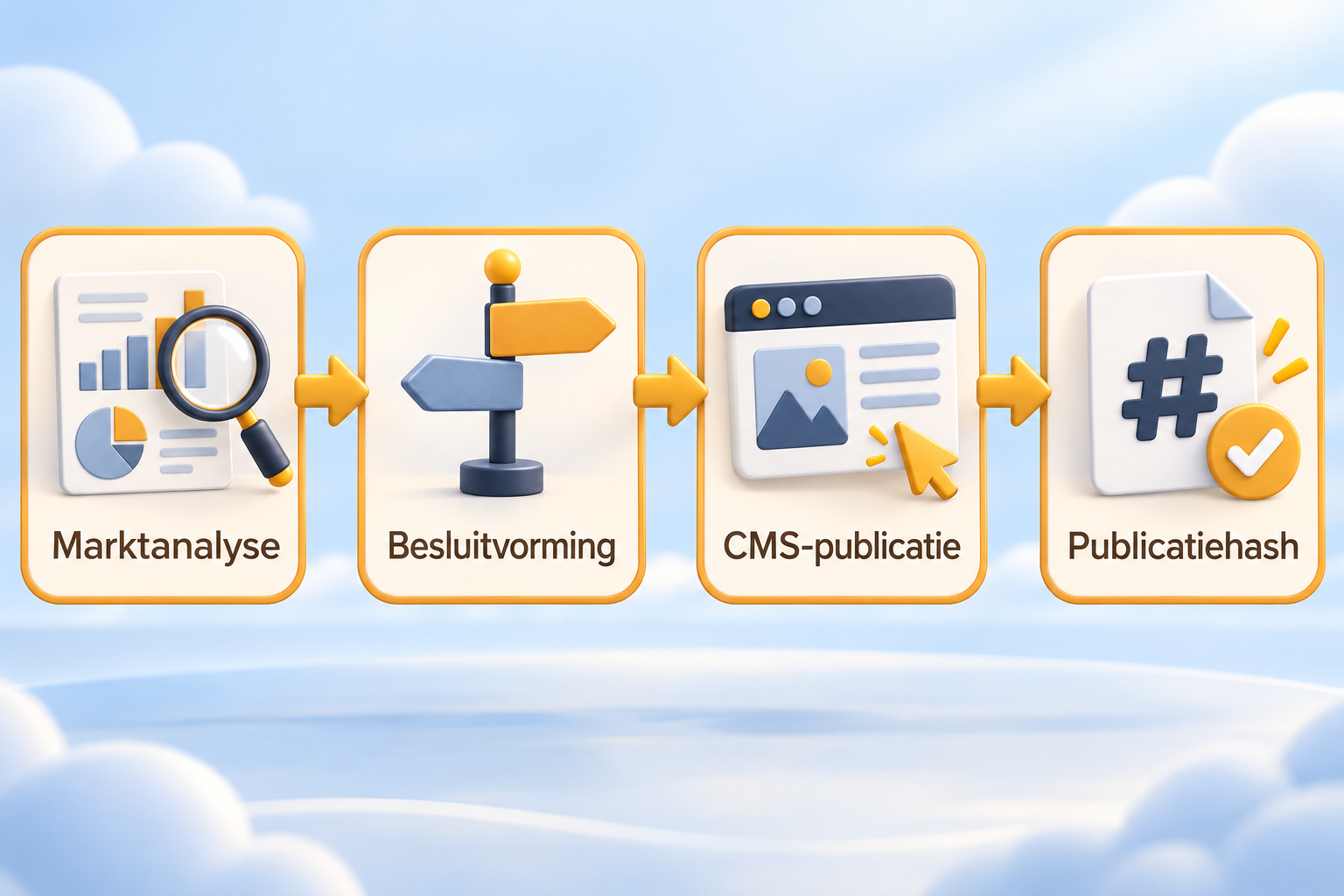
Assess an audit trail as a single, unbroken provenance chain, not as a collection of separate log entries. From the initial market analysis through the final CMS publication, the chain must show how a recommendation was created, assessed, and executed.
| Control point | What the vendor must be able to show | Why this matters for the assessment | Question for demo or due diligence |
|---|---|---|---|
| Initial market analysis | A time-stamped record of the analysis from which the recommendation began. That record must be part of the same provenance chain as the later decision-making. | The reviewer can trace the recommendation back to its starting point instead of seeing only the end result. | “Can you show how a recommendation is linked back to the initial market analysis?” |
| Intermediate decision-making | Immutable, time-stamped logs recording which steps took place between analysis and publication. | The chain shows that there is no unexplained gap between research, decision-making, and execution. | “Which log entries are retained when a proposal is modified or advanced?” |
| Provenance and integrity | A technically demonstrable, unbroken provenance chain. Reporting must preserve the relationship between the parts of the process. | The organization can determine afterward which sequence of events was associated with the publication. | “How do you demonstrate that the recorded chain has not been silently altered?” |
| Reporting | Exportable reports of the recorded information. | Control must not depend solely on a screen in the platform. An organization must be able to include the relevant data in its own assessment. | “Which audit information can we export, and how is the coherence of that information kept visible?” |
| CMS publication | The final CMS publication hash as the closing element of the provenance chain. | This connects the audit trail to the specific published artifact, not just to an earlier draft. | “Can you show the publication hash and link it to the preceding analysis and decision-making?” |
Auditability by design means here that control does not need to be reconstructed afterward from scattered files. Immutable, time-stamped logs and exportable reports make the provenance chain from market analysis to CMS publication hash technically demonstrable.[3]
The relevant vendor test is therefore whether the information an accountable leader needs is available in a coherent form. Without a connection between the analysis, the intermediate decisions, and the publication, it remains unclear whether the organization is assessing the right recommendation or merely an isolated endpoint.
How do you test whether human publication control is technically enforced?
Use this test sequence in a vendor demo. Each step examines whether the roles and permissions around generating, approving, and publishing work technically, rather than existing only as a process agreement. When setting up review capacity, also consider your own measurement data: a correction rate of 18–25% and 35–45 minutes of validation time per brief can provide insight into the practical burden of human control.
- Show the AI service account’s permissions. Check whether this account has draft-only permissions. An account performing AI-supported processing may be able to create or update a draft within that role. The test is not whether the process document mentions human review, but whether the account itself can perform a publishing action. Exclusive draft permissions keep AI output on the draft side of the chain.[3][2]
- Show which human roles may publish. Ask which authenticated human roles have publication permissions and how the platform scopes those permissions. Publication then becomes a separate authority, not an automatic continuation of generating a draft. This setup makes visible who may make the transition to an external communication.[3][2]
- Follow one draft from generation to approval. Have the vendor show that a draft does not merely change status, but requires a human role to take the publication step. This tests the division of responsibility between whoever or whatever generates, whoever reviews, and whoever publishes. Role-based permissions can provide a concrete control layer for this.[3][2]
- Ask what happens in the event of an anomaly. The route must include automatic fallback to a safe draft status when an anomaly occurs. Have the vendor demonstrate what status the item receives and whether the AI service account still has no publication right. A safe draft status keeps the content out of the publication flow until an authenticated human role handles the situation.[3][2]
- Test the boundary, not just the normal path. Do not ask only for a successful publication with all the correct roles. Show what happens when an account without publication permission tries to complete the final step. The value of permissions management becomes evident precisely when the unauthorized path cannot proceed.
- Record the demo as a selection requirement. Note what was demonstrable at each step: draft permissions for the AI service account, limited publication permissions for human roles, and fallback in the event of anomalies. This creates an auditable assessment of the publication chain without assuming that RBAC resolves all other AI governance questions.
Frequently asked questions about approval gates and AI governance
These questions distinguish formal sign-off from ordinary review and focus on what a platform must demonstrably retain throughout the full decision chain.
Does every AI output need executive approval?
No. The executive route is intended for recommendations that establish a direction with major external consequences and are difficult to correct later. Internal, recoverable edits can remain reviewable within the team, so human attention stays available for the decisions that need it most.[1][2]
How does an approval gate differ from ordinary content review?
An ordinary review is an assessment of a proposal, draft, or edit. An approval gate is a required sign-off point before execution. The difference lies in the effect of the assessment: without approval at a gate, the next step does not proceed. In an ordinary review, the assessment may result in commentary or correction without a formal stop/go decision being made.
Which audit information must a platform be able to show?
Ask for an unbroken trail from the initial market analysis through intermediate decision-making to the final CMS publication. That trail must clarify which recommendation was assessed, which steps preceded it, and how the published artifact is connected to it. The full chain is needed to allow an accountable reviewer to inspect not only an outcome, but also its provenance.
Why are publication permissions more than a workflow status?
A status can indicate that a draft appears ready for publication. It does not prove that an unauthorized account cannot publish it. Publication permissions concern the technical boundary between a draft and an external communication. When that boundary is not restricted to authenticated human roles, a procedural agreement about review remains dependent on compliance rather than enforced authorization.
A platform earns trust only when control is also workable
The shortlist for an integrated AI-driven content strategy platform should not be determined by how many recommendations it can produce. The decisive question is whether the organization can identify, explain, and constrain the decisions with the greatest external consequences before they affect the content chain.
Human accountability becomes workable only when the route from recommendation to execution is visible. An accountable leader must be able to assess a strategic recommendation in the context of the analysis used, the decision recorded, and the point at which that decision moves forward. Explainability is therefore not an explanation alongside the process. It determines whether the organization can account for a decision to its own accountable leaders.
Publication then requires a separate technical test. A procedure in which a team agrees that a human will always review does not provide a closed path when permissions are not bounded. Practice must demonstrably show that AI-supported generation does not automatically lead to external publication and that an authenticated human role takes the required step.
The setup remains proportionate when formal gates for direction-setting choices are combined with team review for recoverable edits. This keeps the workflow usable without allowing strategic decisions to flow through unnoticed.
This is also where the operational risk of overly broad manual review lies. When every draft, every edit, and every local deviation follows the same route, waiting times and handoffs arise that make automation less useful. When the organization opens that route too widely, the opposite risk emerges: publications and strategic choices for which no clear accountability trail exists later. A platform selection must be able to test both boundaries demonstrably; otherwise, broad manual review causes both waiting times and loss of automation benefit.