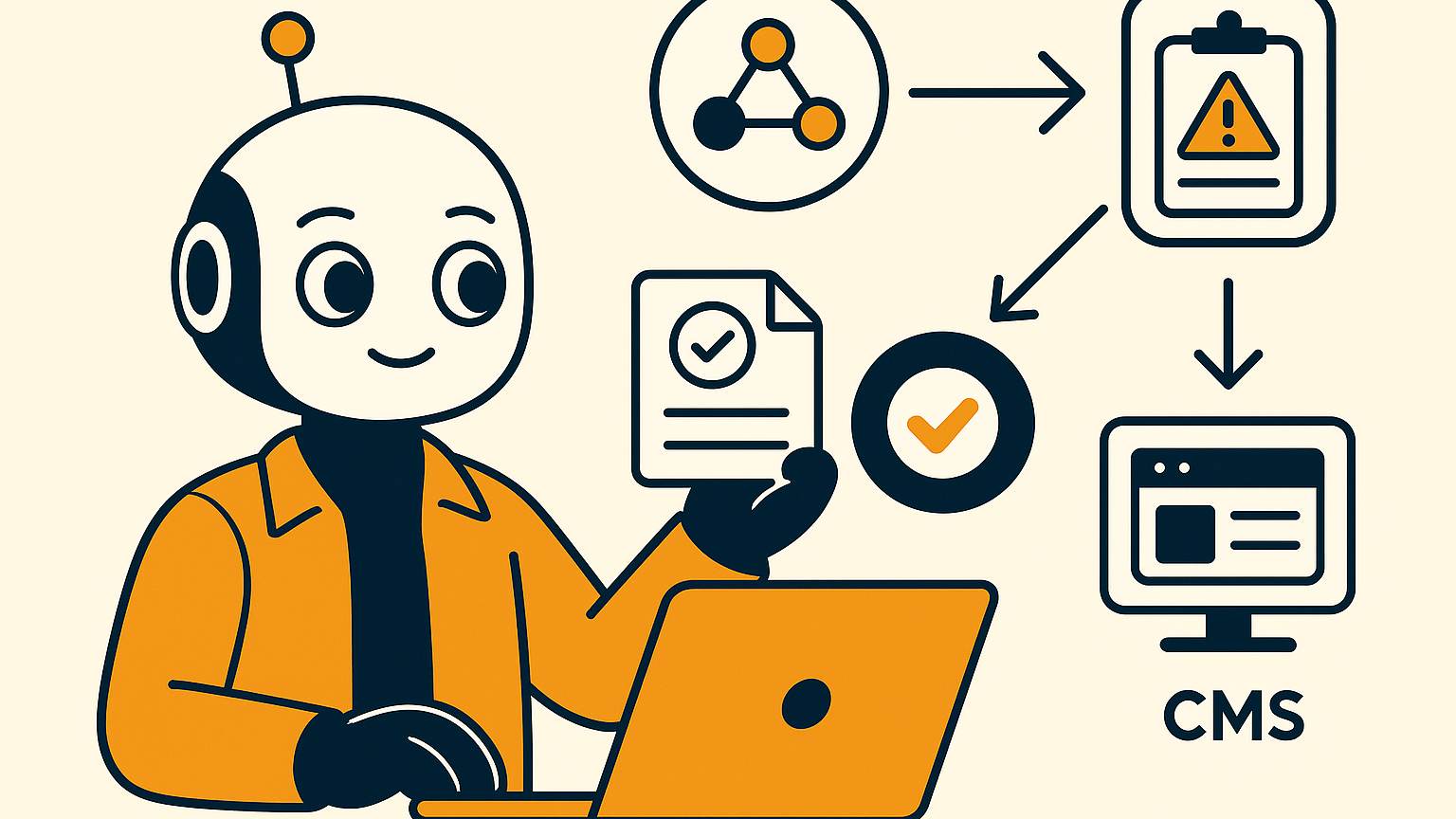
Set up the workflow so that content is differentiated by risk before human review, while reviewers assess only exceptions and brand-critical claims with immediately available source support. Connect briefing, validation, and CMS publishing in one traceable chain, so manual rewriting, searching for sources, and transferring data do not become a fixed additional step.
Key takeaways from this article
Do not evaluate an AI content platform by the speed of its first draft, but by the amount of rework and handoffs that remain after generation.
- Have routine and brand-critical content follow different review routes so scarce expertise remains available for content with greater consequences.
- In a demo, test whether factual claims can be traced directly to the underlying source during review; for complex or regulated topics, this grounding is more essential.
- Measure the operational burden behind the output: complete rewrites by senior staff, reprompting, review queues, and manual data transfers can still make fast drafts expensive.
- Choose between the flexibility of separate tools and the process discipline of an integrated chain based on the traceability required; audit information must be retained from briefing through publication.
- Check governance and data protection separately from content quality: formal safeguards support control, but do not prove that every claim is correct.
A workable AI content workflow starts before the first draft
Selecting an AI content platform does not begin with the question of how quickly it produces a draft. The relevant question is whether the platform connects the full workflow: from briefing and validation to CMS publishing. This coherence determines whether quality control becomes part of production or emerges afterward as a separate rework operation. When teams have to move information between separate steps, the risk of data leaks, copy-and-paste errors, and lost audit information increases. A platform evaluation should therefore make visible where a brief is captured, where checks take place, which decisions are made during review, and how that information carries through to publication.
For a lean team, this is a capacity issue. The same employee often combines marketing and editorial responsibilities. If that person must manually review, correct, and forward every draft, quality control becomes the factor slowing down the production flow. Automated quality gates can distribute that pressure differently. They place a checkpoint before the full human review, so content does not indiscriminately end up in one broad review queue. This does not mean human review disappears. Its practical value lies precisely in protecting scarce human attention from routine rework.
The requirement you set for source grounding should scale with content risk. With greater domain complexity or stronger regulatory pressure, mandatory source grounding is a selection requirement for factual accuracy. In these situations, it is not enough for a draft to sound plausible afterward; the supporting evidence must be present in the workflow. For less complex content, the assessment may differ, but the relationship remains the same: the greater the potential consequences of an incorrect factual statement, the more strongly source grounding must be built into the process.
A vendor demo therefore provides usable evidence only when the entire chain is visible. Show not only generation, but also the transition from briefing to control and from control to CMS publication. Ask where audit information is retained when a draft is edited or validated. This shifts the evaluation from individual features to the operational question that matters to a small team: can the process maintain quality without employees having to manually reassemble the chain every time?
Sources for this section: actionai.co, tendem.ai
Fast AI drafts become expensive when experts must rebuild the basics
The speed of an AI draft says little about the final turnaround time when the draft is not sufficiently usable for the editorial context. Ungoverned ad hoc prompting can lead to subtle hallucinations and generic copy. The work is then not removed from the editorial team, but shifted to internal experts who must repair drafts substantively. The chain is predictable: fast first versions cause extra corrections, pressure on experts increases, and editorial burnout becomes a risk. When that burden persists for too long, teams revert to slow manual content creation. The original speed gain then disappears from the process.
A second cause lies in an undifferentiated approval workflow. If routine texts and high-risk content go through the same heavy review protocol, the queue grows in exactly the wrong place. Even simple items then demand substantial time from the same people who must assess strategic articles. This accumulation can cause review fatigue among marketing leads. The paradoxical result is that strategic or high-risk claims are ultimately checked superficially because of time constraints, even though the uniform protocol was intended to strengthen control.
These two patterns show why quality control cannot be treated as a final step. Ad hoc prompting creates rework because drafts provide insufficient grounding. A single heavy process for all content creates delays because human attention is not differentiated according to the nature of the content. In both cases, expertise is used for work that does not require the same degree of review, while content that does carry greater weight may receive less attention than necessary.
You should therefore evaluate an AI content platform by how it organizes review work, not solely by the quality of a demonstration draft. The relevant test is whether the process prevents every first version from becoming an assignment for experts to rewrite the basics, and whether it prevents all content from going through the same long approval loop. Only then does review capacity remain available for the cases in which human assessment is genuinely needed.
Sources for this section: actionai.co, tendem.ai
Two review patterns make AI output unusable for a lean team
The first red flag is the Heroic Editing Trap. In this pattern, AI delivers drafts quickly, but the visible speed does not match the actual distribution of work. Senior employees take on the rewriting of flawed output. More than 70% of their time can be spent on manual rewriting. This is not merely an editorial inconvenience: the scarcest capacity is spent repairing source material rather than on the assessment that requires seniority. A platform can therefore produce many drafts while creating little productive capacity if those drafts systematically require a complete rewrite.
The second red flag is the Homogeneous Review Trap. Here, every content item receives the same heavy approval process. At first glance, this may seem careful, but capacity is not allocated according to the nature of the content. Routine texts consume time that is also needed for strategic articles. Once the queue grows, an unfavorable effect emerges: strategic articles are checked superficially due to lack of time. The issue is therefore not the existence of review, but the identical treatment of content that can have widely varying consequences.
In addition to these recognizable patterns, there is a direct operational burden. Lean teams spend 3 to 13 hours per employee each week manually correcting AI errors, reprompting, and transferring data. This time is not a general measure of potential time savings; it is a concrete indication of hidden corrective work that increases the cost per article. Reprompting requires renewed attention to a draft already in production. Manual correction adds rework. Transferring data also makes the process dependent on actions outside the actual substantive review.
These are therefore signals to investigate closely during a platform evaluation. Do not ask only how much output a solution can generate, but also who repairs that output, how often drafts must be redirected, and how much handoff remains before an article is ready. If senior employees primarily rewrite, or if every item follows the same heavy route, AI output remains operationally unusable for a lean team. The financial consequence lies not only in the platform itself, but in the recurring hours needed to make drafts publishable after all.
Sources for this section: actionai.co, tendem.ai
Compare ease of generation with the review burden the platform leaves behind
Use a demo to make the distribution of work behind draft generation visible. The comparison below does not ask for a promise about output, but for observable evidence of how governance and human attention are organized in the workflow.
| Trade-off | Question during the demo | Evidence of a workable setup | Risk when this evidence is absent |
|---|---|---|---|
| Generation speed versus depth of governance | What upstream input does the platform require before content is generated, and what review work remains afterward? | The demonstration shows that more input upfront is used to significantly reduce downstream review time. Not only does the draft appear, but the workflow also shows how it prevents editors from having to extensively repair the draft manually. | Low-cost prompt tools can deliver drafts within seconds while increasing the manual editorial burden. A fast first version then becomes the beginning of additional work rather than a usable step toward publication. |
| Full automation versus protection of domain expertise | Can the workflow route content using automated thresholds, or does every item end up with an expert? | The demonstration shows risk routing in which human review is directed toward exceptions. Experts therefore do not handle every sentence, but are deployed where the workflow indicates that further assessment is needed. | Uncontrolled publication creates brand-critical risks. Mandatory expert review for every sentence, by contrast, blocks team capacity. Both extremes show that automation and review are distributed incorrectly without routing. |
| Low-risk versus brand-critical content | Can these content types demonstrably follow different review paths? | Ask for one demonstration using low-risk content and one using brand-critical content. The relevant evidence is that the platform does not send both items through the same review path, but differentiates human attention based on risk. | Without different paths, either a broad approval burden arises for all content or insufficient control is applied to content with brand-critical consequences. It then remains unclear where domain expertise is actually protected. |
Sources for this section: actionai.co, tendem.ai
Test the workflow for routing before review and sources during review
A vendor demo can demonstrate the presence of quality control through two consecutive actions: first, routing content before human review; then, factual validation within that review. Do not ask for a general description of control, but for visible content that goes through both actions.
- Have the automated quality gates classify content. Ask how content is categorized before review based on claim density and brand-critical impact. Differentiated risk routing distributes the control burden by using these characteristics in advance. The question is therefore not whether every text is checked, but which content is treated as an exception by the workflow. A demo without visible categorization shows, at most, generation and manual review, not the routing that should distribute the review burden.
- Follow the exception to the reviewer. Then show what happens after an item is marked as an exception. Evidence of a workable workflow lies in a process where reviewers primarily inspect exceptions rather than treating every item according to the same path. Human review remains present, but it is given a defined role. If the reviewer still has to review every draft fully and in the same way, the earlier classification has no demonstrable operational function.
- Open the source at the factual claim. In the review interface, ask for a generated factual statement and have the platform show that it is directly linked to a source document. Native source attribution makes the support available where the decision takes place. The domain expert then does not first have to search for sources again before the substantive assessment can begin. The role shifts from a fact-checker searching for evidence to a decision-maker assessing the available support.
- Assess the two forms of evidence as one chain. Routing without source links can still lead to time loss during exception review because the reviewer must reconstruct the factual basis independently. Source attribution without routing, on the other hand, can mean that all content requires the same attention. The demo only shows a complete quality flow when it determines in advance which items need additional attention and the reviewer can directly check the linked support for factual claims.
Sources for this section: actionai.co, ap.org, tendem.ai
When do separate tools and an audit trail still leave the workflow vulnerable?
An audit trail is useful only when it follows the complete process chain. Evaluating a platform therefore involves two separate questions: does information about briefing, validation, and publication remain centrally traceable, and can the vendor demonstrably provide formal safeguards around governance and data?
- Are separate tools inherently unsuitable? No. Separate tools offer flexibility. However, that flexibility comes with the risk of data silos and copy-and-paste friction. Once information moves manually between tools, the coherence between process steps can weaken. For quality control, this means data from one step does not automatically remain available in the next. The presence of separate generation and review features is therefore not enough to demonstrate traceability across the entire route.
- What does an integrated pipeline offer instead? An end-to-end platform can ensure central audit trails and process discipline. This allows the chain to be followed as a whole rather than as separate handoffs. There is a genuine trade-off: an integrated pipeline requires workflow standardization and may be more rigid. The evaluation is therefore not about maximum flexibility, but about whether the chosen standardization leaves sufficient room for the work process while also keeping the required audit information intact.
- Which governance signals are testable? Formal alignment with NIST AI RMF 1.0, ISO/IEC 42001, and the EU AI Act is a verifiable signal in vendor evaluation. In addition, Enterprise-grade security and a guarantee that customer data is not trained publicly can be assessed. These signals supplement the audit trail: they show which formal principles for AI governance and data protection a vendor applies. On their own, they do not prove that every substantive decision is correct.
- Is an audit trail sufficient without an integrated chain? Not when that record stops at a handoff between tools. A useful audit trail must remain visibly connected to the process steps in which content is prepared, validated, and published. Otherwise, the team remains dependent on manual reconstruction to determine what happened earlier. The vulnerability then lies not only in the content, but also in the loss of process discipline during handoffs.
Sources for this section: verifywise.ai, konfirmity.com
Choose verifiable quality, not just fast production
The final test for an AI content platform is not whether it can show a convincing draft. It is whether a claim, its support, and the control action can demonstrably come together in the same workflow. Native knowledge grounding and direct source attribution make this test concrete when claims in the interface are linked to verified source documents and version dates. The reviewer can then see not only that a source exists, but also which source supports the factual statement and which version applies.
This requires a second form of visibility: configurable quality gates, immutable audit trails, and verifiable content provenance. These elements clarify which checks have been performed in the workflow and how content was created. Content provenance standards, such as C2PA and watermarking, can support editorial transparency and verifiability. The selection threshold is therefore not the presence of one separate feature, but the demonstrable coherence between source control, checkpoints, and records.
If the connection between these components is missing, daily work remains dependent on reconstruction. Employees must then search outside the workflow for which support belonged to a claim, which check took place, and who was responsible for a decision. This again consumes limited review capacity and leaves uncertainty at the moment a substantive choice must be explained. For a lean team, that uncertainty translates directly into additional operational time and a higher cost per article.
Sources for this section: ap.org
This article does not provide legal advice. Applicable obligations depend on the purpose, functionality, user context, and risk classification of the system. Have the specific application legally assessed before production use.