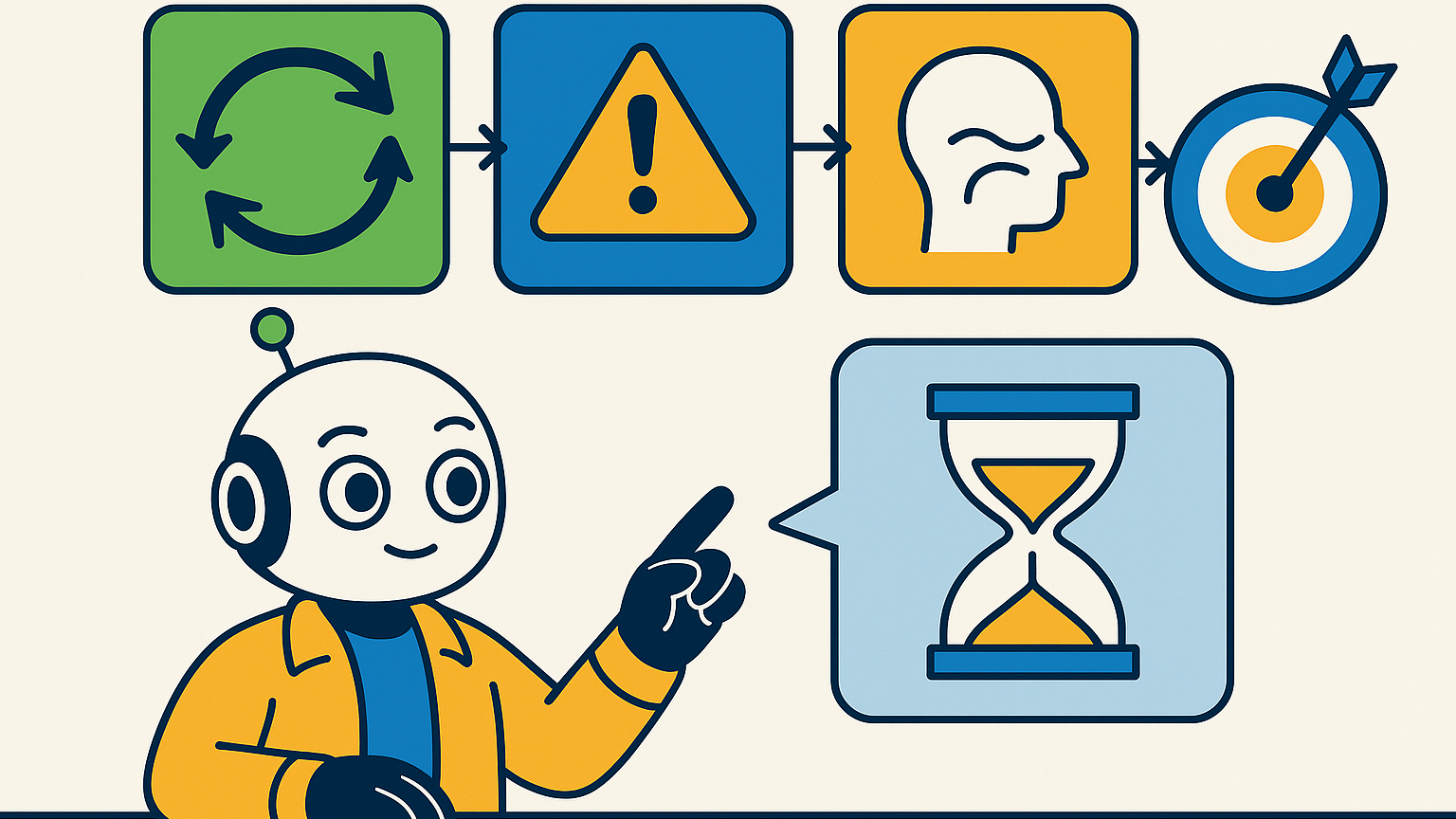
Decision Intelligence is needed when a decision must be made within a narrow time window based on incomplete but relevant evidence, additional analysis is expected to yield less than the cost of delay, and the remaining uncertainty is explicitly manageable. For reversible choices, this can be done with low switching costs, a recovery path, and active monitoring; for irreversible capital allocation with high downside exposure, targeted tests of the supporting assumptions and the z
In brief: evidence for time-critical decisions
The required evidence threshold depends not only on urgency, but above all on recoverability, potential harm, and the value of additional information.
- Distinguish between decisions that can still be practically adjusted after implementation and choices whose financial consequences are difficult to reverse.
- Stop additional research when the expected improvement from new information does not outweigh the cost of waiting; do assess whether the analysis aligns with operational, contractual, and legal constraints.
- Keep facts, provisional assumptions, and open hypotheses visible so that time pressure does not lead to false certainty or untested premises.
- Ensure one shared fact base when departments view the same decision through conflicting KPIs or assumptions.
- Link the assumptions underlying a decision to concrete signals and predetermined review points so that adjustments remain possible after approval.
- Report uncertainty as ranges, possible scenarios, and sensitivity to assumptions rather than as one definitive outcome.
A lower evidence threshold requires a genuine recovery path

Urgency and decision readiness are not the same thing. A short decision window can limit the scope for additional analysis, but it does not automatically make a decision responsible on the basis of an incomplete fact base. The relevant question is therefore not how much evidence is available in the abstract, but whether a decision can still be meaningfully adjusted after implementation if an assumption proves incorrect.
When reversibility is high, the evidence threshold may be lower. Low switching costs and modular contracts are the conditions for a recovery path: the chosen direction can be adjusted without having to rebuild the entire decision. In that situation, around 70% evidence can be a useful internal guideline, provided active monitoring after the decision is part of the approach. This percentage is not a universal standard, nor is it permission to ignore missing knowledge. It works only in a context where the organization continues to test after implementation whether the selected assumptions hold up and can genuinely make adjustments.
That distinction changes the meaning of time pressure. If a decision is reversible, the focus shifts from complete certainty in advance to the quality of the recovery path afterward. It is then defensible to act on a partial but sufficiently relevant body of evidence. Without low switching costs, modular arrangements, and active monitoring, however, the practical basis for that lower threshold is absent. A decision can then be made quickly in formal terms while the room to correct an error is in fact limited.
A second boundary lies within the organization itself. Functional fragmentation and conflicting KPIs mean that departments view the same decision from different assumptions. The delay then results not only from a lack of information, but because there is no shared starting point for what counts as fact, assumption, or relevant consequence. Separate analyses by function do not solve this; they may instead make the differences more visible without making them actionable.
A central fact base for Decision Intelligence brings these differing assumptions together. It makes clear which points are shared, where interpretations conflict, and which uncertainties truly underpin the decision. Its purpose is not to eliminate every difference, but to prevent inconsistent assumptions from blocking decision speed. A lower evidence threshold is therefore defensible only when both the recovery path and the shared fact base are present.
Sources for this section: decisionprofessionals.com
Time pressure does not turn provisional assumptions into facts
A time-critical decision often starts from evidence that is relevant but incomplete. That is not necessarily a shortcoming: reality may develop faster than research can be completed. The risk arises when the pressure to act blurs the distinction between what can be demonstrated and what is provisionally assumed. Once implementation begins, a working hypothesis can easily acquire the status of a premise. If that status is not explicitly recorded, the reason to test it further also disappears.
This pattern is known as Assumption Amnesia. Under time pressure, a team acts on provisional assumptions without formally recording them as untested hypotheses. During the implementation phase, those assumptions then quietly transform into undisputed facts. The transition need not happen consciously. Precisely because a decision is translated into operations, the original uncertainty can disappear from view. What was initially a caveat is then treated as though it were an established fact.
The harm lies not only in the possibility that an assumption proves wrong. The quality of later discussion also deteriorates. If it is no longer clear which parts of a decision rest on evidence and which parts rest on a hypothesis, a team cannot properly interpret changes. New information then appears unexpected or contradictory, when in reality it affects an earlier untested premise. The organization subsequently discusses the outcome rather than the assumption that supported that outcome.
An evidence threshold is therefore not about creating apparent certainty. It determines when the available evidence is sufficient to make a decision while the remaining uncertainty remains explicitly recognizable. In this context, Decision Intelligence adds more than collecting additional information: it preserves the separation between facts, provisional assumptions, and hypotheses that still require testing. That separation does not make a rapid decision less ambitious, but it does make it controllable.
This shifts the core question. Not: has all uncertainty disappeared? Rather: is it clear what uncertainty remains, what it relates to, and which parts of implementation depend on it? When provisional assumptions formally retain their hypothetical status, an organization can act without pretending that time pressure has transformed evidence into certainty.
Sources for this section: rand.org
Irreversible capital allocation shifts the boundary toward targeted stress tests
Not every decision with financial consequences requires the same evidence threshold. The boundary shifts significantly when capital allocation is irreversible and material downside exposure is high. In that combination, the question is not whether more analysis is possible, but whether the assumptions capable of causing the greatest loss have already been tested sufficiently. A decision that cannot easily be reversed tolerates less unknown vulnerability than a decision with a credible recovery path.
This situation does not call for a generic request for a more extensive report. Before implementation, targeted stress tests are needed for fat-tail risks and supporting assumptions. That focus is decisive. Fat-tail risks direct attention to heavily weighted downside outcomes, while supporting assumptions indicate the premises on which the decision rests. The testing therefore does not seek a broader description of everything that may be relevant, but the assumptions and risks that determine material exposure.
This is also where the limit of ad hoc deepening lies. Data and research teams can spend thousands of hours on detailed reports that are already outdated upon delivery. In a time-critical context, that is not merely inefficient. The report may answer a question that the decision window has already overtaken. Additional analytical capacity then produces documentation, but no timely, usable support for the choice at hand.
That does not mean time pressure is a reason to skip testing. For irreversible capital allocation with high material downside exposure, delay for targeted stress tests is precisely justified. This delineation prevents two opposing mistakes: implementation based on untested supporting assumptions, or broad reporting that arrives too late to remain relevant. The appropriate form of Decision Intelligence concentrates the remaining research on what can genuinely change downside exposure.
The decision rule is therefore clear: the less room for recovery and the greater the material downside exposure, the less appropriate a rapid conclusion based on general analysis becomes. The time still available should then go toward the specific stress test of fat-tail risks and supporting assumptions, not toward an ad hoc detailed report whose usefulness may expire before delivery.
Sources for this section: strategicdecisionsolutions.com
Additional analysis has value only if EVSI exceeds Cost of Delay
The choice between waiting and acting can be assessed along two separate dimensions. The first concerns the economic benefit of a new analysis cycle; the second concerns the context in which the outcome must be implemented. A positive answer on the first dimension alone is insufficient when the model is disconnected from the organization’s actual constraints.
| Assessment dimension | Question | Meaning for the decision |
|---|---|---|
| Economic value of additional information | Is the Expected Value of Sample Information (EVSI) greater than the Cost of Delay? | An additional analysis cycle is economically rational only when EVSI is greater than Cost of Delay. EVSI concerns the expected value of the additional sample information; Cost of Delay makes clear that waiting itself has a cost. When the expected information value does not exceed that cost, the new cycle adds no economic justification under this guideline. The assessment is therefore not about the attractiveness of more information in itself, but about the improvement that information is still expected to produce before delay has its consequences. |
| Domain and context sensitivity | Does the decision model directly align with the organization’s operational, contractual, and legal constraints? | A model becomes decision-relevant by directly incorporating these constraints. Operational conditions determine the implementation context; contractual conditions limit what is possible within agreements; legal conditions likewise form part of the context in which a decision lands. Without this integration, an analysis may appear economically convincing but fail to fit the circumstances under which implementation takes place. Context sensitivity reveals whether the analysis concerns the actual decision rather than a separately abstracted version of it. |
Sources for this section: ispor.org
Record assumptions and link them to signals that compel review
Assumption-Based Planning provides a concise implementation sequence for decisions where complete certainty is not available in advance. This method does not replace stress tests for irreversible capital allocation. It does clarify what a decision rests on, which signal may contradict that foundation, and when a review can no longer be postponed. In this way, uncertainty remains connected to implementation rather than disappearing once a proposal passes through decision-making.
- 1. Name the assumptions that support the decision. Explicitly link the decision to the premises on which the chosen direction depends. An assumption that is not named cannot later be challenged or revised purposefully. This step does not create more certainty than exists; it makes the remaining uncertainty visible and traceable. It therefore makes clear that the decision rests on a combination of available information and explicit hypotheses.
2. Record disconfirming signals for each assumption. Determine which signals would contradict an assumption. In Assumption-Based Planning, these are explicit disconfirming signals: signals that not only add new information but also prompt a reassessment of the validity of the premise. The decision therefore does not remain dependent on an implicit expectation that the original hypothesis will prove correct. - 3. Connect the signals to adaptive triggers. Establish adaptive triggers that initiate review as soon as the designated signals occur. The value lies in the predetermined link between a disconfirming signal and an adjustment to the decision basis. The organization then does not first need to determine again whether the signal is relevant; that relationship is already part of the decision design. This supports decision safety without waiting for exhaustive certainty in advance.
4. Prevent the method itself from becoming a permanent blockage. Pragmatic proposals can become structurally stuck in bureaucratic committees. That undermines execution capability and increases decision fatigue. Explicit signals and triggers instead bound the discussion: they focus reassessment on the assumptions that contradict a decision, rather than reopening every proposal without a defined reason. The practical test is not whether all uncertainty disappears, but whether it is clear which signal compels a review.
Sources for this section: rand.org, strategicdecisionsolutions.com
Reporting uncertainty without creating false certainty
Incomplete evidence does not need to be packaged as a single unambiguous outcome. Methodological transparency makes clear what the available information does and does not support. This gives uncertainty a recognizable place in decision-making without automatically becoming a reason for unlimited further analysis.
- How can a team make uncertainty visible with confidence intervals?
Confidence intervals make the uncertainty around an outcome explicit. Rather than presenting one seemingly fixed number or one definitive estimate, they show that the evidence contains a range. The reader therefore sees not only the direction of the information, but also that the outcome should not be treated as absolute certainty. This form of reporting does not turn uncertainty into an obstacle; it makes it methodologically recognizable within the available body of evidence.
How do probabilistic scenarios and sensitivity analyses replace false certainty?
Probabilistic scenarios show different possible outcomes as probabilistic possibilities, rather than as one narrative that will necessarily unfold. Sensitivity analyses also reveal how dependent an outcome is on the assumptions on which it rests. Together, these approaches shift the discussion from an apparently certain answer to the question of which uncertainties determine the outcome. This is explicit methodological transparency: the organization does not present more certainty than the evidence can support, but does show how uncertainty has been incorporated into the assessment.
This approach is especially useful when speed puts pressure on the presentation of results. A tight decision window can increase the temptation to omit nuance so that a proposal appears more definitive. Confidence intervals, probabilistic scenarios, and sensitivity analyses offer an alternative: they keep uncertainty visible rather than concealing it. This preserves the distinction between what the evidence supports, which outcomes are conceivable, and which assumptions are sensitive to change.
Sources for this section: decisionprofessionals.com
Decision readiness remains verifiable with an audit trail of expiry conditions
A time-critical decision does not end at the moment of approval. Its rationale must also remain verifiable later, precisely because the circumstances on which the decision rests may change. This requires a formalized audit trail of the supporting assumptions. The record not only makes visible which hypotheses supported the original choice, but also preserves the distinction between an assumption and an established fact after implementation has begun.
The audit trail gains meaning only when it states, for each supporting assumption, under which market conditions the hypothesis expires. This links reassessment to recognizable change in the market, rather than to a general feeling that the decision may need to be revisited. The expiry condition is the testable point at which the basis of the earlier choice comes under review again.
This creates a different form of decision readiness. The organization does not need to pretend that uncertainty has been fully resolved before implementation, but it can record what the choice rests on and when that support is no longer valid. An audit trail therefore does not make the decision immutable. It keeps visible the conditions under which continuation of the chosen direction remains defensible.
The operational consequence of the absence of such a record is concrete: a decision can continue based on hypotheses that are not reassessed under changed market conditions. For a decision with material consequences, that lag can translate into financial or operational exposure. Without recorded expiry conditions, the verifiable point at which a supporting assumption must be tested again is absent.
Sources for this section: rand.org, decisionprofessionals.com